Hearing plays a vital role in how we connect with the world around us. From chatting with family and friends to enjoying music, television, or the sounds of nature, good hearing supports communication, independence, and overall wellbeing. Yet many adults are unsure what normal hearing actually means — or how to tell if their hearing has changed over time. This uncertainty often leads people to delay seeking help, even when everyday listening starts to feel more difficult.
The term “normal hearing range” is commonly used by hearing professionals, but it can sound technical or confusing if you’ve never had a hearing test. In simple terms, it describes how softly a person can hear sounds across different pitches and still be considered to have healthy hearing. Understanding this range can be reassuring, but it can also be an important first step in recognising early signs of hearing loss.
Hearing changes are especially common as we age. Many adults over 50 notice that conversations seem muffled, background noise feels overwhelming, or certain voices — particularly higher-pitched ones — are harder to understand. These changes often happen gradually, which makes them easy to dismiss as “just getting older.” However, even mild hearing loss can have a real impact on communication, confidence, and quality of life if it goes unaddressed.
This guide explains the normal hearing range in clear, everyday language. It looks at how hearing is measured, what counts as normal for adults, and why both loudness and pitch matter when it comes to understanding speech. Knowing what’s normal gives you a helpful reference point and empowers you to take action if something changes.
What Does “Normal Hearing Range” Mean?
When hearing professionals talk about the normal hearing range, they are referring to how well a person can hear sounds of different loudness and pitch compared to what is considered typical for healthy ears. Hearing is not a single ability; it is measured across a range of volumes and frequencies to determine how clearly sounds are detected and understood.
Hearing is assessed using two main measurements: decibels (dB) and frequencies (hertz or Hz). Decibels describe how loud a sound needs to be before you can hear it, while frequencies describe how high- or low-pitched that sound is. Together, these measurements give a detailed picture of hearing ability.
For adults, normal hearing is generally defined as the ability to hear sounds between 0 and 25 decibels (dB HL) across the main speech frequencies. This means very soft sounds — such as quiet speech or gentle background noise — can be heard without effort. When sounds must be louder than 25 dB before they are detected, hearing is no longer considered within the normal range.
Normal hearing does not mean perfect hearing. Even people with normal hearing may struggle in noisy environments or feel tired after long conversations. Normal hearing simply means the ears are functioning within expected limits for detecting sound.
A common misconception is that hearing loss only refers to difficulty hearing loud sounds. In reality, many people with early hearing loss hear loud noises well but struggle with softer speech sounds, particularly consonants. This is why people often say, “I can hear you, but I can’t understand you.”
Understanding Decibels: How Loud Is Normal Hearing?
Decibels, or dB, measure how loud a sound is. In hearing tests, professionals use dB HL, which compares your hearing to what is considered typical for healthy ears.
Normal hearing means being able to hear sounds between 0 and 25 dB HL. Within this range, soft sounds such as whispering or quiet conversation are audible. Once sounds need to be louder than this, hearing is no longer classed as normal.
Many everyday sounds fall within this range. Quiet breathing is around 10 dB, a soft whisper about 20 dB, and gentle rainfall roughly 30 dB. Someone with mild hearing loss may struggle with soft speech, especially in noisy places, even though louder sounds are still heard clearly.
Decibel changes can be subtle. A shift from 20 to 30 dB may seem small, but it can significantly affect speech understanding. Because the decibel scale is logarithmic, even small increases represent a much larger change in sound intensity.
This explains why hearing loss is often overlooked. You may still hear the television, phone, or doorbell but find conversations tiring or frustrating. Understanding decibels helps explain why normal hearing is about detecting soft sounds, not just loud ones.
Understanding Frequencies: Why Pitch Matters for Speech
Frequencies describe the pitch of sounds and are measured in hertz (Hz). The human ear can typically hear sounds between 20 Hz and 20,000 Hz, but speech mainly falls between 250 Hz and 6,000 Hz.
Lower frequencies carry vowel sounds, which give speech its volume. Higher frequencies carry consonants such as “s,” “f,” “th,” and “k,” which provide clarity and meaning. Missing these higher-frequency sounds makes speech seem unclear, even when it is loud enough.
Age-related hearing loss usually affects high frequencies first. This is why many adults struggle to understand speech in noisy environments or find women’s and children’s voices harder to hear. Background noise masks high-frequency sounds, making conversation more difficult.
Hearing loss rarely affects all frequencies equally. Many people retain good low-frequency hearing but lose sensitivity to higher pitches. This is why turning up the volume doesn’t always solve the problem — clarity depends on hearing the right frequencies, not just louder sound.
What Does Normal Hearing Look Like on a Hearing Test?
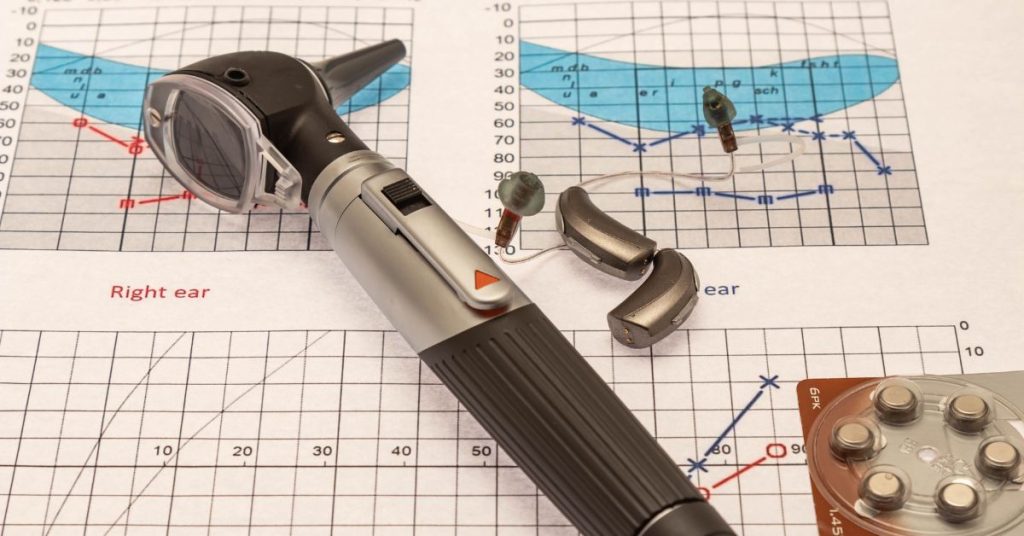
Hearing tests measure how softly you can hear sounds at different frequencies. Results are displayed on an audiogram, a chart that shows pitch across the top and loudness down the side.
Normal hearing appears on an audiogram as responses between 0 and 25 dB HL. If your hearing thresholds fall within this range, your hearing is considered normal.
Audiograms also show differences between ears and the pattern of hearing loss. Many adults show normal hearing at low frequencies with reduced hearing at high frequencies — a common age-related pattern.
Understanding audiograms makes hearing tests less intimidating. A hearing test is quick, painless, and provides valuable insight into hearing health, even when hearing loss is mild.
When Is Hearing No Longer Normal?
Hearing is no longer considered normal when sounds must be louder than 25 dB HL to be heard. Hearing loss is classified as mild, moderate, moderately severe, severe, or profound.
Mild hearing loss (26–40 dB) often affects soft speech and conversations in noise. Moderate hearing loss makes normal conversation difficult without repetition. More severe levels can significantly limit awareness of everyday sounds.
Even mild hearing loss can affect confidence, social interaction, and mental wellbeing. Many people withdraw from conversations due to listening fatigue or frustration.
Recognising hearing loss early allows for better outcomes. Early support may include monitoring, communication strategies, or hearing aids designed to improve speech clarity.
Why Knowing Your Hearing Range Is Important as You Age
Knowing your hearing range helps detect changes early. Hearing loss often develops slowly, making it easy to adapt without realising what’s happening.
Good hearing supports social connection, independence, and brain health. When hearing is unclear, the brain works harder, leading to fatigue and reduced concentration.
Understanding hearing health removes stigma. Hearing loss is common and manageable, and modern hearing solutions are discreet and effective.
Routine hearing checks should be part of healthy ageing, just like eye tests. Knowing your hearing range puts you in control and helps protect quality of life.
Conclusion
Understanding the normal hearing range helps adults recognise when hearing changes occur. Normal hearing typically means hearing sounds between 0 and 25 decibels across speech frequencies.
Hearing loss often affects clarity before loudness, making it easy to miss early signs. Awareness allows for early action, better communication, and improved wellbeing.
Hearing health is central to staying connected and confident. A simple hearing test can provide reassurance or guidance, helping ensure hearing remains a strength rather than a barrier.
FAQ
What is considered a normal hearing range for adults?
Normal hearing is the ability to hear sounds between 0 and 25 dB HL across speech frequencies.
Is it normal for hearing to decline with age?
Yes. Age-related hearing loss is common, especially in higher frequencies, but early support can help.
Can you have hearing loss if sounds seem loud enough?
Yes. Many people hear loud sounds but miss speech clarity due to frequency loss.
How often should adults have their hearing tested?
Every few years, or sooner if you notice changes.
When should I be concerned about my hearing?
If you struggle in noise, ask for repetition, or avoid conversations, a hearing check is recommended.
This article is for informational purposes only and is not a substitute for professional medical advice, diagnosis, or treatment. If you are concerned about your hearing or ear health, please consult a qualified healthcare provider.